Observing Orion's Bracelet
A long-predicted stellar companion to Betelgeuse may have been found

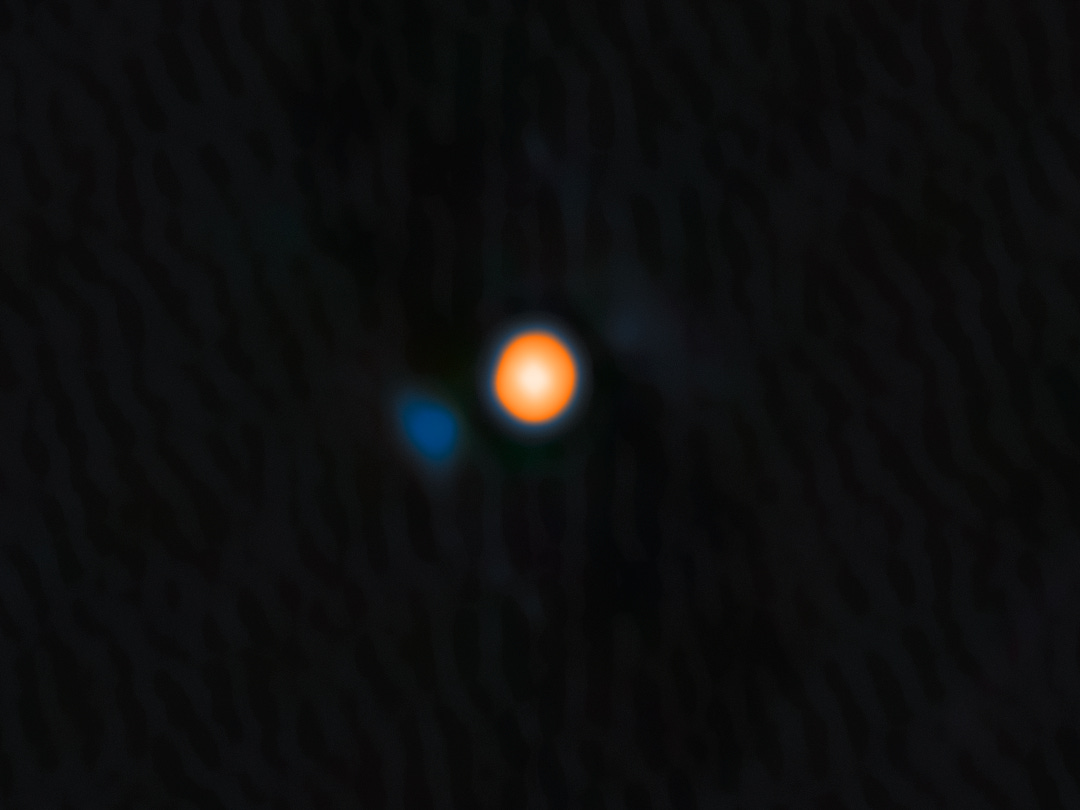
Betelguese, the prominent red star near the tip of Orion, may have just revealed a companion that has been predicted for over a century.
Steve Howell, an astronomer at the NASA Ames Research Centre, lead a team hunting for the supergiant star’s proposed partner, spurred on by recent work that made similar predictions using decades worth of data.
With the ‘Alopeke speckle imager on the 8.1 metre Gemini North telescope in Hawai’i, the researchers took two sets of images separated by several years, comparable to the companion’s predicted orbit.
The first set of images was in February 2020, when the companion was thought to be hiding behind Betelgeuse. As predicted, Howell and his team could find no trace of it.
The second set was taken in December 2024, when the companion was believed to be at the maximum distance in its orbit from its parent. In these images, there was a faint cluster of photons which the authors believe match the predictions.
In normal circumstances, the detection would be considered too faint to be genuine. However, the researchers are confident as the star’s current and previous positions strongly agree with the theory.
One way to improve confidence in this measurement is to observe it again, once it has orbited to the other side of Betelgeuse. However, this is not predicted to occur until around November 2027.
The author’s limited measurements mean they cannot confidently determine many of the companion’s properties. Their detection suggests that the companion is around 6 magnitudes fainter than Betelgeuse and likely has a mass of around 1.6 times that of the Sun.
In the meantime, the authors have proposed a new name for this potential companion. Betelgeuse means “Hand of the Giant,” with “Elgeuse” being both a historical Arabic name for the Orion constellation and a feminine name in Arabian legend. Given the new companion orbits the hand of the giant, they suggest it should be named Siwarha, or “Her Bracelet.”
Source: Howell et al (2025) - The Probable Direct-Imaging Detection of the Stellar Companion to Betelgeuse; accepted for publication in The Astrophysical Journal: Letters